


As the automotive industry continues to get more fierce, brands like Suzuki are doing their best to remain competitive. In this Japanese automaker’s case, its electrification plans will call for even more efficient models and shorter development times. This has been revealed at Suzuki’s Technology Strategy Briefing 2026, wherein it outlined its future product plans.
Like every Japanese automaker, Suzuki will still forge through a multi-pathway approach. Internal combustion engines (ICE) will remain in its lineup for markets that still demand such powertrains. Meanwhile, the automaker will continue to develop mild-hybrids and full hybrids, whilst utilizing and integrating these electrification technologies with its electric vehicles (EVs).
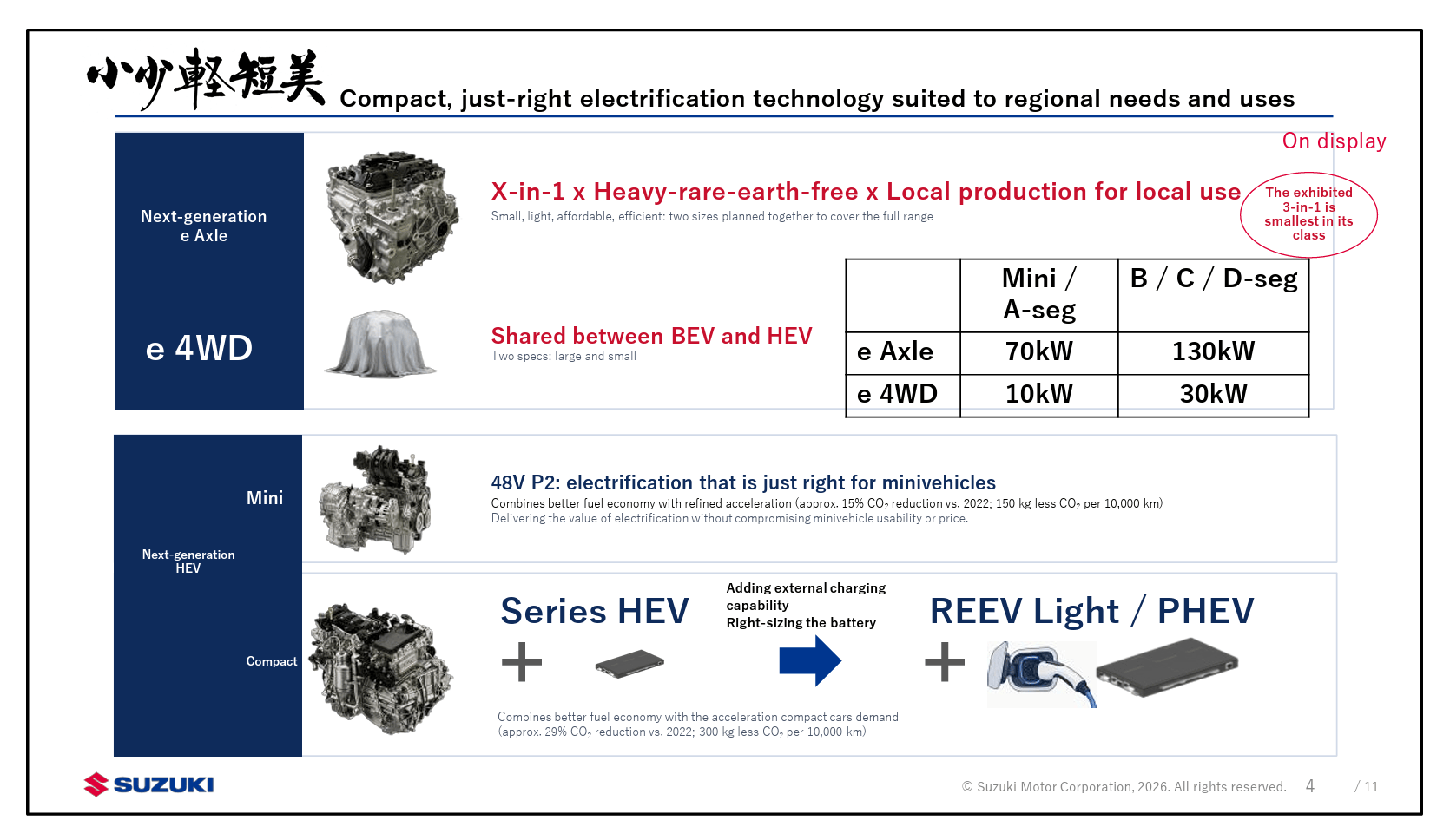
For instance, the newly announced Suzuki e-Sky kei car specific to Japan currently uses a 3-in-1 e Axle. In the coming years, this will evolve to a 6-in-1 unit whilst still retaining the current e Axle’s size. This e Axle will also be utilized not just for its EVs, but also for its hybrids as well. When utilized for bigger compact cars, the e Axle is targeted to only increase its volume by 10 percent versus the e Axle being used for the kei car class. Furthermore, to minimize geopolitical risk whilst also improving sustainability and recyclability, the e Axle will be free of heavy rare earths.
Suzuki is also developing e 4WD (four-wheel drive) for snowy regions, and this will also be unified for both hybrids and EVs. By sharing basic designs for both hybrids and EVs, Suzuki can reduce its development costs.
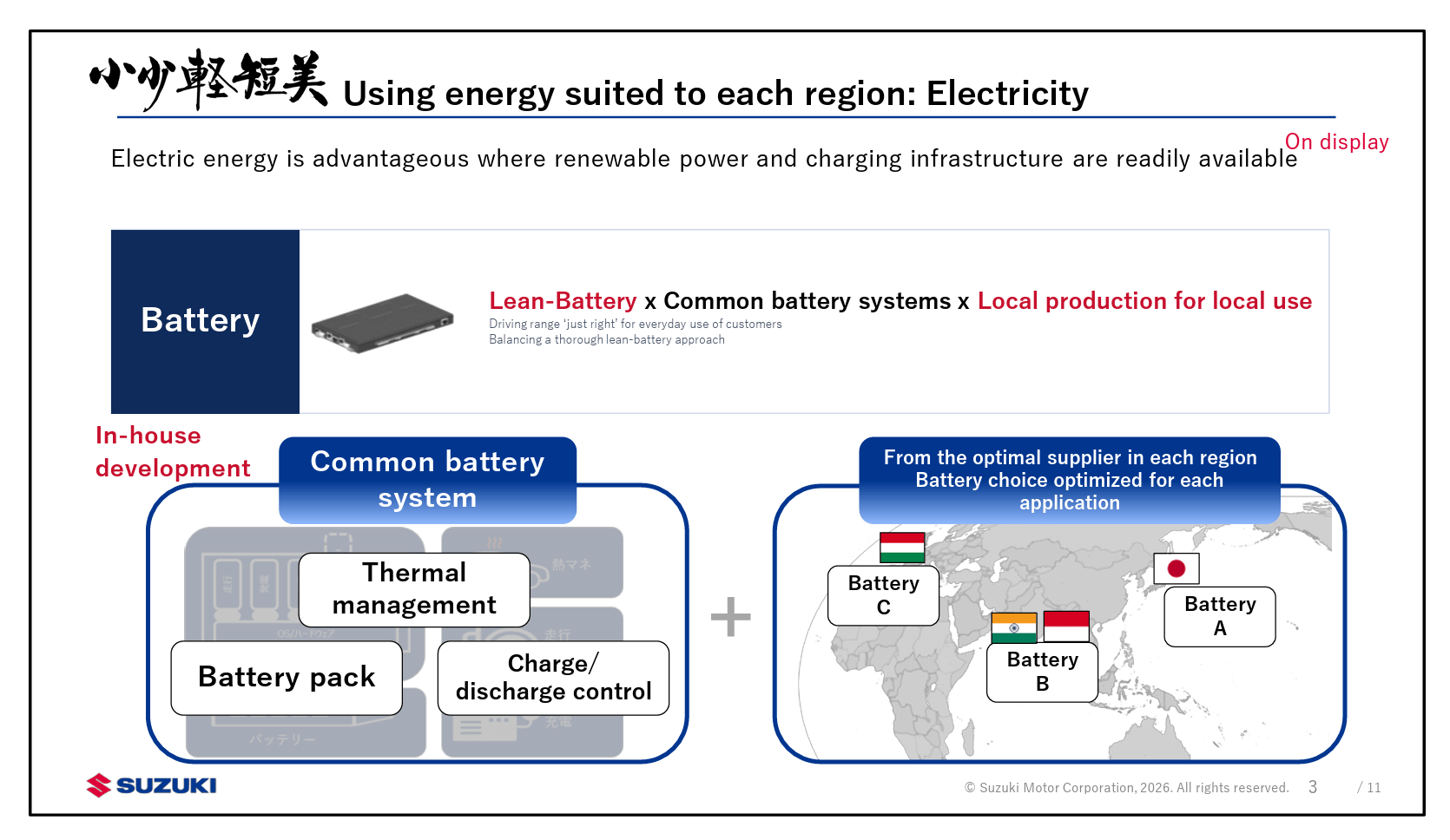
Though battery system development is also being conducted in-house, Suzuki is also aiming to use the optimal battery for each region and application, such as Japan, India, and Europe, and secure it from the optimal supplier. Since the company says that its expertise is building light vehicles, it says that it can deliver the required performance of a hybrid or an EV with a smaller battery as it pursues a “lean battery” approach. This means matching the battery to how customers use their vehicles, thus holding down resource use and vehicle weight
Apart from EVs, Suzuki is also developing a new series hybrid. Series hybrids, just like Nissans’ e-Power, only lets the engine charge the battery, but it never powers the wheels. It will eventually evolve into a light range-extender electric vehicle (REEV Light), which uses a right-sized battery to keep weight down. The series hybrid and REEV will be developed with a common foundation as a family.
Lastly, for the pursuit of continued ICE development, Suzuki is working on various fuels like compressed natural gas (CNG), which is a popular fuel choice in India, and a next-generation DITC direct-injection turbo gasoline engine that aims to achieve 50 percent thermal efficiency.For now, it is Geely who has the ICE with the highest thermal efficiency at 48.41 percent, so reaching 50 percent will be a monumental achievement.
The Chinese have become known for their rapid development times, and Suzuki aims to compete with this speed by halving its development times to just 24 months by 2030. To achieve this, boosting development efficiency by 30 percent and production efficiency by 50 percent at its Manesar plant in India.
0 comments on “Suzuki’s Latest Electrification Plan Includes A Range Extender EV”